

Indexing is when search engines analyze a page and store it in their database.
During indexing, Google looks at text, images, videos, title elements, alt attributes, and other page signals to understand what the page is about. Not every crawled page is guaranteed to be indexed.
Ranking
Ranking is when search engines order results for a user’s query.
Search engines rank pages based on relevance, quality, usefulness, location, device, intent match, and many other signals. Google also makes clear that payment does not improve organic crawling, indexing, or ranking.
Suggested visual:
User search → crawler discovers page → page gets indexed → algorithm ranks page → result appears in SERP.
How Does SEO Work?
SEO works by improving the signals that help search engines and users understand, trust, and use your website.
When someone asks what is SEO and how it works, the answer is this: SEO improves your content, technical setup, internal linking, authority, and user experience so your pages can compete in organic search.
SEO helps search engines understand:
- What the page is about
- Who the page helps
- Whether the content is trustworthy
- Whether the page can be crawled and indexed
- Whether the content satisfies search intent
SEO Starts with Search Intent
Search intent means the reason behind a search.
Common search intent types include:
- Informational intent — the user wants to learn something.
- Navigational intent — the user wants a specific website or brand.
- Commercial intent — the user is comparing options.
- Transactional intent — the user is ready to buy, book, or contact.
For example, “what is SEO” is informational. “best SEO agency for startups” is commercial. “hire SEO consultant” is transactional.
SEO Uses Content, Technical Health, and Authority
Most SEO work falls into three areas:
| SEO Area | What It Means | Example |
| Content relevance | Helping users answer a query | A complete beginner guide |
| Technical accessibility | Helping search engines crawl index pages | Sitemap, speed, mobile usability |
| Authority and trust | Showing credibility | Backlinks, reviews, expert authors |
Google’s helpful content guidance says content should be made for people first, not mainly to manipulate search rankings. It also encourages original, complete, and useful content.
SEO Is Not a One-Time Task
SEO needs regular work.
You need to monitor performance, update old pages, fix technical issues, improve content, build authority, and study new search queries.
A page that ranks today may lose traffic later if competitors publish better content, user intent changes, or technical issues appear.
What Are the Main Types of SEO?
The main types of SEO are on-page SEO, technical SEO, off-page SEO, and local SEO.
Each type supports a different part of seo search engine optimization. A healthy strategy uses all of them together.
| Type of SEO | Main Focus | Examples |
| On-page SEO | Content and page elements | Titles, headings, internal links |
| Technical SEO | Crawlability and performance | Speed, indexing, structured data |
| Off-page SEO | Authority outside your website | Backlinks, mentions, reviews |
| Local SEO | Visibility in local search | Google Business Profile, citations |
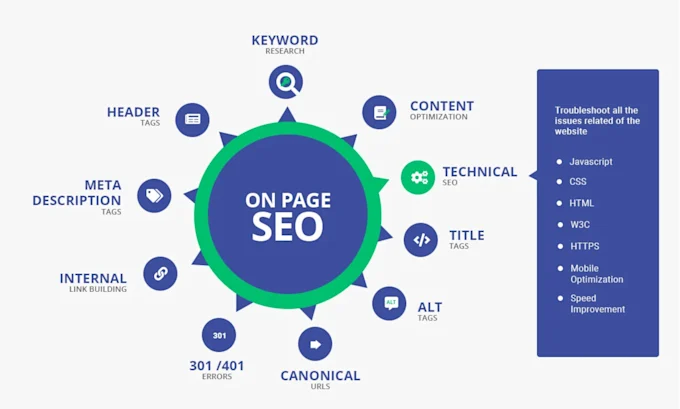
What Is On-Page SEO?
On-page SEO means improving the content and HTML elements on a page.
It includes:
- Title tags
- Meta descriptions
- H1, H2, and H3 headings
- Search intent match
- Internal links
- Image descriptive alt text
- Content quality
- URL structure
A good on-page SEO page is clear for users and easier for search engines to understand.
What Is Technical SEO?
Technical SEO means improving the technical health of your website so search engines can access, crawl, render, and index it.
It includes:
- Crawlability
- Indexing
- Page speed
- Mobile-friendliness
- HTTPS
- Structured data
- XML sitemaps
- Canonical tags
- Clean site structures
Google’s SEO guide highlights common improvement areas such as URLs, titles, descriptions, images, structured data, Search Console, crawling, indexing, and technical discovery.
What Is Off-Page SEO?
Off-page SEO means improving trust and authority outside your own website.
It includes:
- Backlinks
- Digital PR
- Brand mentions
- Reviews
- Citations
- Community visibility
- Social media visibility

Backlinks are not about buying spam links. They are about earning references from relevant and reputable websites.
What Is Local SEO?
Local SEO helps businesses appear for searches in specific locations.
It is important for dentists, restaurants, real estate companies, repair services, clinics, law firms, and local shops.
Local SEO includes:
- Google Business Profile
- Local citations
- Reviews
- Local landing pages
- NAP consistency: name, address, phone number
- Location-based content
Google Business Profile lets businesses appear on Google Search and Maps, add photos, offers, posts, business hours, and respond to reviews.
What Is the Difference Between SEO, SEM, and PPC?
SEO earns organic visibility, PPC buys paid clicks, and SEM is often used for a wider search marketing strategy.
Search Engine Land explains organic search as unpaid traffic from search results and paid search as ads where advertisers pay for clicks.
| Channel | Meaning | Traffic Type | Cost Model | Best For |
| SEO | Search Engine Optimization | Organic | Time, content, expertise, tools | Long-term visibility |
| PPC | Pay-per-click advertising | Paid | Pay for clicks | Fast traffic |
| SEM | Search Engine Marketing | Organic + paid search, depending on usage | Mixed | Wider search strategy |
SEO is usually slower than PPC, but it can build long-term value. PPC can bring faster traffic, but traffic often stops when the budget stops. Search Engine Land also notes that organic traffic can compound over time, while paid search is useful when a business needs quick visibility.
What Does SEO Include?
SEO includes keyword research, content optimization, technical improvements, internal linking, authority building, and reporting.
A complete SEO process is not just writing blogs. It connects strategy, content, technical work, and measurement.
Keyword Research
Keyword research means finding the words and questions people search.
For example:
- what is seo
- what is seo marketing
- what is seo optimization
- what does seo stand for
- what is local seo
- what is technical seo
Good keyword research looks at search volume, difficulty, intent, business value, and content gap.